 DYNAMIC
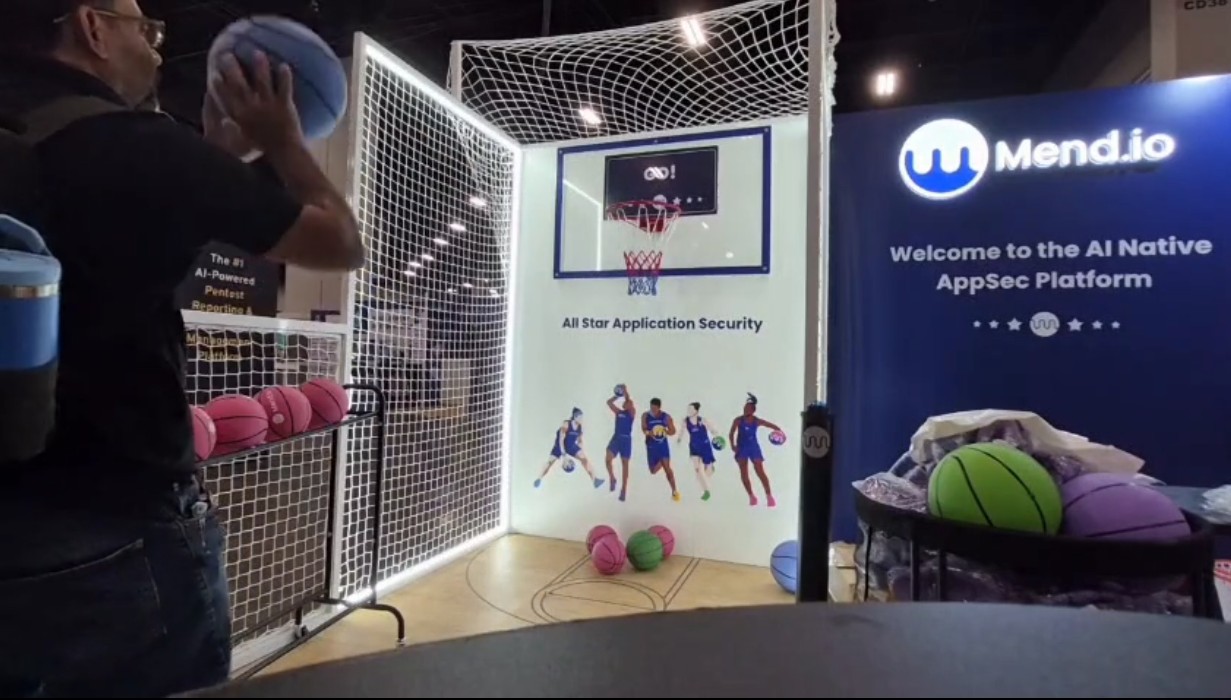
A touchscreen is the easy answer for a trade show game. A physical interface, such as a big button, a pad you hit, a ball you throw or a gesture in the air, is what makes people stop walking. It is also the part that breaks first. This is how we build custom hardware that lasts the whole show.
Why physical interfaces beat touchscreens at a booth
Physical interaction is visible from across the aisle, needs no instructions and is fun to watch, so it pulls in a crowd. The mend.io basketball arcade starts with a single flashing button: one press, a three second countdown, then fifteen seconds to score. The Matrix Reaction Game asks visitors to hit a physical button at exactly the right moment. The Jazz Security rhythm game uses four touch-sensitive pads. XM Cyber had visitors kick to score, and Mint Security used hand tracking so players could pinch and rescue objects in mid air without touching anything.
Designing for thousands of hits
At a busy booth an interface gets thousands of presses, slaps and kicks from people who have never seen it before, and nobody reads instructions. We design for that from the first sketch.
Switches and sensors are industrial grade and rated far beyond the number of hits we expect. Every cable has strain relief and a locking connector, and nothing is left where a visitor can pull it or trip on it. Enclosures are CNC milled or 3D printed around the electronics and the brand, and they open easily for service. The firmware expects noise: it debounces inputs, calibrates sensors at startup and filters readings, so a hard hit counts once and a near miss doesn't count at all.
Custom electronics, and when a camera does it better
We design the electronics around the experience, not the other way around: microcontrollers, button matrices, touch and pressure sensing, motion and distance sensors, LED drivers for lit buttons and props, and the wiring between them. When a camera or depth sensor does the job better than a physical sensor, as with tracking a ball, a kick or a hand, we use computer vision and plan the lighting and mounting so tracking stays reliable in a crowded hall.
Built to recover by itself
Nobody should need a laptop to restart a game at 9am on day three. Our setups boot straight into the experience, reconnect hardware automatically, use watchdogs to recover from faults and fall back to an attract screen instead of showing an error. We log what happens, so a tired sensor shows up in the logs before it fails.
Test in the studio, not at the show
Every build is assembled and run for long sessions before it ships, with repeated presses, power cuts, pulled cables and full play sessions. We pack spare switches, sensors and cables, and the crew on site knows every part because they built it.
Hardware that feeds lead capture
The physical game is also part of the lead funnel. A score only counts once the player registers. A leaderboard brings people back to beat their colleagues. Between rounds, the screens show the brand and the high score table. The mend.io arcade combined all three, with background music and real-time sound effects on top.
Reusable hardware for the next event
Good hardware is an investment. We design props and electronics so they can be rebranded and redeployed: new graphics and game content on the same proven hardware at the next event. That lowers the cost of every show after the first.