 DYNAMIC
Most interactive experiences live on a screen of some kind, and picking the wrong one is expensive: an LED wall that looks blurry at two meters, a projection washed out by hall lighting, or a budget spent on resolution nobody stands close enough to see. This is how we choose between LED walls, LED floors and projection mapping for trade show booths, visitor centers and lobbies.
LED walls: the default for trade show booths
LED is the usual choice on a show floor because it stays bright under strong hall lighting and has no visible seams between panels. The spec that matters most is pixel pitch, the distance between pixels in millimetres.
What pixel pitch do you need?
A common rule of thumb: the closest comfortable viewing distance in meters is roughly the pitch in millimetres. A 2.5 mm wall looks sharp from about 2.5 m. Most people stand further back than that, so two to three times that distance is the comfortable zone.
Interactive walls need a finer pitch than display walls, because people walk right up to them. If visitors touch the wall, throw things at it or stand next to it, plan for a fine pitch, or design content that still holds up close.
Content at native resolution
An LED wall is a grid of cabinets, so its resolution is rarely a standard video size. We design and render content for the exact pixel map, so the processor never has to scale or crop it.
Phone cameras
Visitors film everything. A good refresh rate and the right processor settings keep the wall from flickering in phone video.
For the CATO Networks ball game at RSA, players threw a real ball at a large LED wall to knock down virtual servers. The wall had to take the impact, track the ball in real time and still look good on video. At CES 2025, the Foretellix interactive brand wall responded to movement and presence, so the booth backdrop itself became the experience.
LED floors: the floor becomes the interface
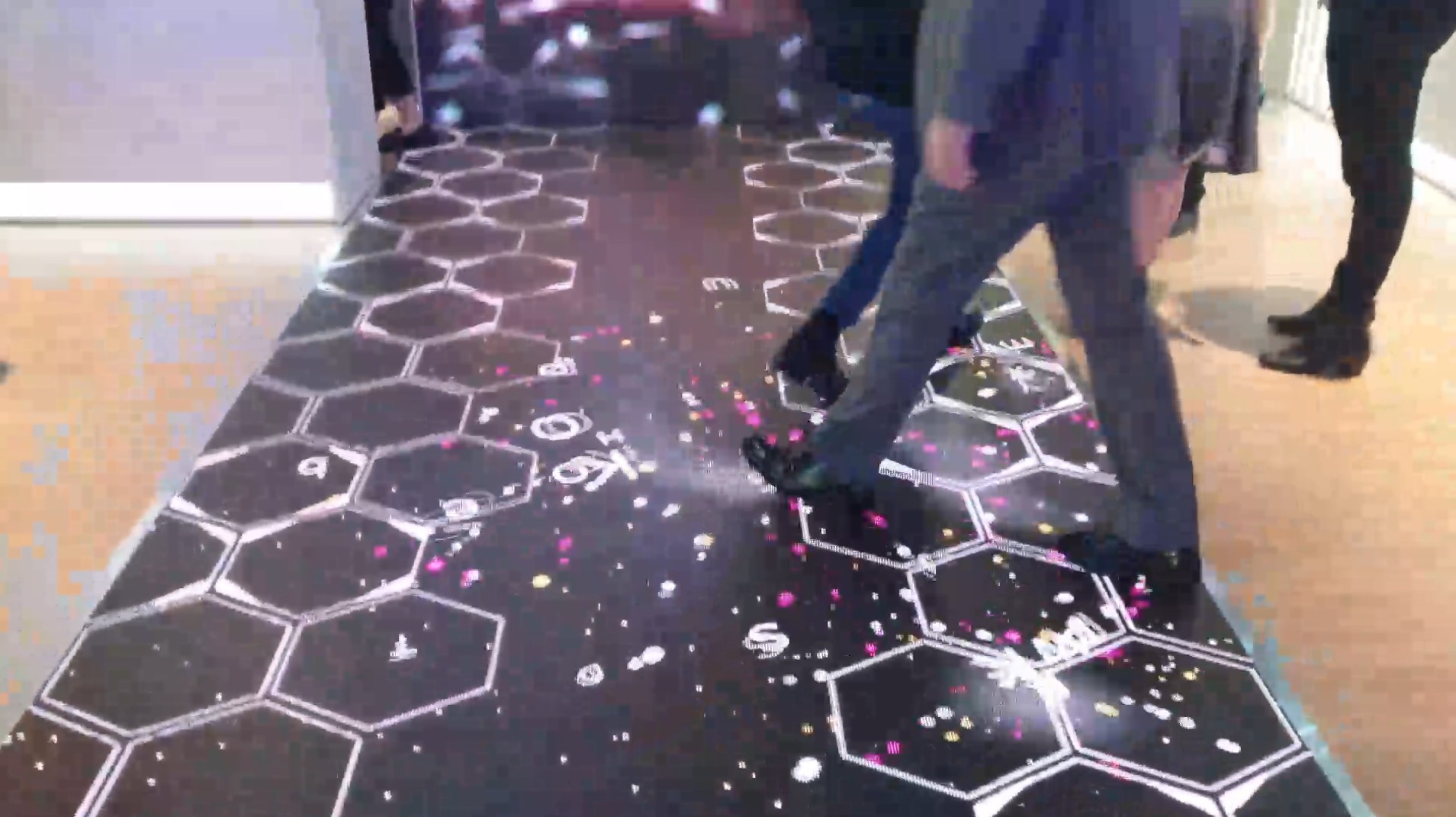
A walkable LED floor turns movement into input, so every step can trigger light, sound or a game. Floors use a coarser pitch than walls because people look down at them from standing height, and they need a surface rated for foot traffic with an anti-slip finish. For Amdocs at MWC Barcelona we built an interactive LED floor and walls where the visuals followed visitors in real time.
LED cubes, columns and sculptures
LED does not have to be a rectangle. Cubes, columns and custom structures become landmarks people can find from across the hall. Vega's RSA booth hung a giant LED cube above a themed game world. At Black Hat, Burning Raft turned a large LED structure into a generative sculpture synced to a live DJ set. For shapes like these we build the content in 3D and map it onto each face, so the image wraps around the object.
When projection mapping is the better choice
Projection mapping turns objects, set pieces, walls and building facades into screens. We reach for it when:
- the surface is irregular, such as a sculpture, a car, a 3D set or a textured wall;
- the canvas is very large and LED would blow the budget;
- the light can be controlled, as in a visitor center, a museum room, a lobby at night or a closed off area of a booth.
Whether it works comes down to projector brightness against the room's ambient light, throw distance and lens choice, edge blending where several projectors cover one surface, and calibration precise enough that the content lands exactly on the geometry. Interactive projection mapping adds cameras or sensors so the surface reacts to people.
Permanent displays for lobbies and visitor centers
A display that runs every day has different needs from a four day show. It has to manage heat, use long life components, start and recover on its own, allow remote monitoring, and get fresh content often enough that regular visitors keep looking. The Mobileye headquarters lobby runs a real-time generative system that responds to presence and movement, built for people who walk past it every morning.
Five questions that decide the canvas
- Where will people stand? That sets the pixel pitch or projector resolution.
- How bright is the space? Show halls favour LED. Controlled light opens up projection.
- What shape is the canvas? Flat surfaces favour LED; objects and architecture favour mapping.
- Is it interactive? Then the sensing (cameras, depth sensors, touch or tracking) is designed together with the canvas.
- Is it a show or a permanent install? Permanent installs need reliability and maintenance planned from day one.
We make the content, write the software and integrate the hardware ourselves, so we can pick the canvas that suits the idea rather than bending the idea to whatever screen is available.