 DYNAMIC
"How much does a booth game cost?" is the first question most marketing managers ask, and the honest answer is a range wide enough to be useless on its own. Two games that look similar in a photo can differ in cost several times over.
The useful question is what drives that range. Once you know the factors, you can decide where to spend and where to save before you ask anyone for a quote.
1. Custom game or adapted game
This is the biggest single factor. A game designed from scratch for your brand means a new concept, new art, new software and often new hardware. An existing game adapted to your brand reuses the tested mechanics and changes the look, the text and the rewards.
Adapted games are faster and cost less, and they are already proven on a show floor. Custom games are the right choice when the game itself has to carry your message, like the Matrix reaction game we built for MazeBolt, where the mechanic was built around the attack vectors they protect against. Ask a studio which of its games can be rented and branded before you commit to a custom build.
2. Physical hardware
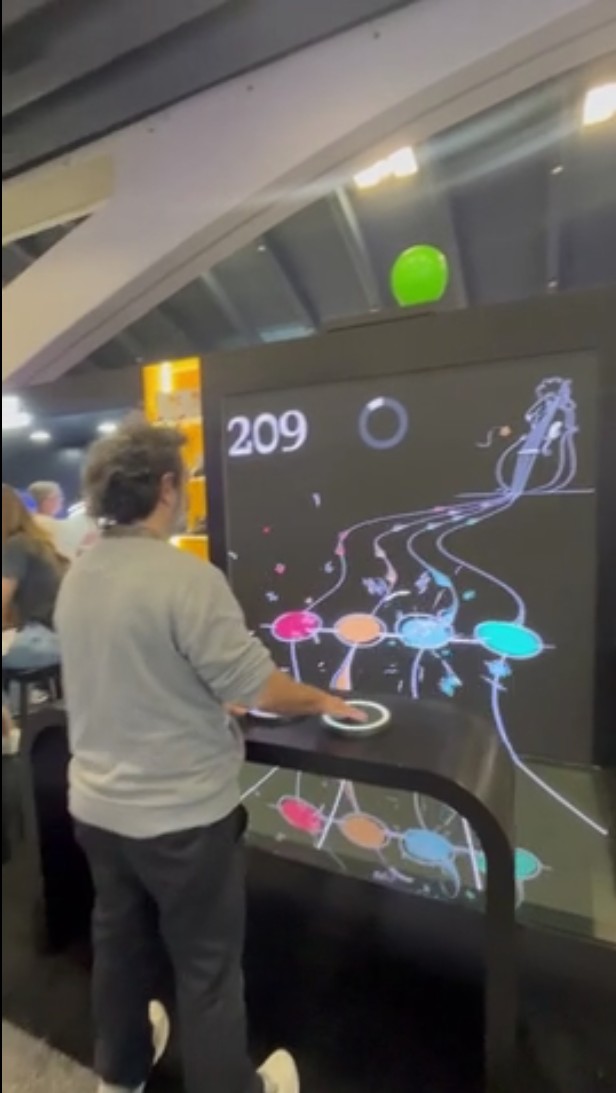
A game played on a touchscreen needs a screen and software. A game played with a ball, a big button, pressure pads or a goal needs all of that plus electronics, enclosures and sensors that survive thousands of hits. The Jazz rhythm game used four touch pads; the mend.io basketball arcade needed a full cage, sensors in the hoop and a start button.
Physical games cost more, and they also tend to pull bigger crowds, because people can see them working from across the aisle. We explain what goes into that hardware in custom hardware built to last four days.
3. Screens, LED and projection
Large LED walls are usually rented for the show rather than bought, and the size, pixel pitch and number of show days drive the price. Projection can be cheaper for very large images but needs control over light. If your booth builder is already supplying LED, the game can often run on it, which saves a second display. Our comparison of LED walls and projection mapping covers the trade-offs.
4. Content and art
A game can look like a template or like your brand. Custom characters, 3D environments, animation and sound design take time. Reusing your existing brand assets keeps this down; an original game world, like the one we built for Vega at RSA, is a bigger creative project.
5. Lead capture and integrations
A leaderboard with names is simple. Badge scanning, a registration flow, CRM integration, prize logic and a dashboard for the sales team each add work. Decide early which data you actually need after the show, because that decides how much of this you build.
6. Shipping, setup and on-site operation
Someone has to install the game, calibrate it in the hall's light and noise, and run it for the whole show. Costs here depend on how many days the show runs, how far it is and whether the studio's operator stays on site or trains your team. For overseas shows, shipping and travel can be a real share of the budget.
7. Timeline
A game built in four months costs less than the same game built in four weeks. Short timelines mean more people working in parallel and less room to reuse. If you know your show calendar, starting early is the cheapest saving available.
8. One show or a whole season
A game built for one conference carries all of its cost into that one event. A game designed to travel, with flight cases, quick setup and swappable content, spreads that cost across every show in the year. If you exhibit at several conferences, ask for a game that can be updated between them.
How to get a useful quote
Send the studio the show name and dates, booth size, your audience, what you want visitors to remember and what data you need afterward. With that, a good studio can come back with options at different levels, from an adapted game to a fully custom build.
Planning a booth for an upcoming show? Send us the details and we will suggest what fits your budget.